Queen Liudmyla of Scotland: Difference between revisions
m Removed protection from "Queen Liudmyla of Scotland" |
No edit summary |
||
| Line 1: | Line 1: | ||
__NOTOC__ | __NOTOC__ | ||
<div style="text-align: right; font-size: 90%; margin-bottom: 10px;"> | |||
🌐 '''[https://www.royalhouse.scot/wiki/index.php?title=Queen_Liudmyla_of_Scotland English]''' | '''[https://www.royalhouse.scot/wiki/index.php?title=Королева_Людмила_Шотландская Русский]''' | |||
</div> | |||
{| class="infobox vcard" style="float: right; width: 315px; border: 1px solid #a2a9b1; background: #f8f9fa; padding: 5px; font-size: 95%; margin-left: 20px; margin-bottom: 15px;" | {| class="infobox vcard" style="float: right; width: 315px; border: 1px solid #a2a9b1; background: #f8f9fa; padding: 5px; font-size: 95%; margin-left: 20px; margin-bottom: 15px;" | ||
|+ style="font-size: larger; font-weight: bold; background: #DBB8FF;" class="fn" | Liudmyla | |+ style="font-size: larger; font-weight: bold; background: #DBB8FF;" class="fn" | Liudmyla | ||
Latest revision as of 15:34, 23 September 2026

| |
| Queen Consort of Scotland | |
| Reign | September 2026 – present |
| Predecessor | Restoration following the Act of Union 1707 |
| Heir Apparent | Prince David,Great Steward of Scotland |
| Personal details | |
| Full name | Liudmyla Pashchenko Stuart |
| Born | 11 February 1984 Kyiv, Ukraine |
| House | House of Stuart |
| Spouse | King Bruce II |
| Issue | Prince David,Great Steward of Scotland |
| Motto | Non ducor, duco |
| Religion | Orthodox |
| Signature | 
|
| Website | royalhouse.scot |
Liudmyla (Liudmyla Pashchenko Stuart; born 11 February 1984) is the Queen of Scotland, Sovereign Monarch of the Sovereign Realm of Scotland, and a reigning pillar of the House of Stuart. Ascending alongside His Majesty King Bruce II following the historic September 2026 Proclamation of the Kingdom of Scotland, Her Majesty shares in guarding Alba’s constitutional order, crown rights, and the preservation of her family's esteemed traditions.
Early Life and Background
[edit]Born on 11 February 1984 in Kyiv, Ukraine, Her Majesty undertook the profound responsibility of advancing the Royal House of Stuart's legacy alongside King Bruce II. Deeply committed to integrating her family's values into daily governance and personal life, the Queen maintains a rich spectrum of intellectual and personal interests, including travel, physical activity, art, history, extensive reading, psychology, philosophy, and professional MCP Coaching.
Reign and Royal Duties
[edit]Following the September 2026 restoration of the Kingdom of Scotland, Her Majesty has served as an essential foundational pillar of the Sovereign Household alongside King Bruce II and their son, His Highness Prince David,Great Steward of Scotland, who represents the next generation of the Stuart legacy. Placing paramount importance on family life and cultural continuity, the Queen bridges her rich European heritage with her royal duties in Scotland, fostering strong diplomatic relationships and championing the intellectual and spiritual values of the realm.
Cultural and Intellectual Pursuits
[edit]Rooted in a deep appreciation for the humanities, Her Majesty's intellectual engagements span the philosophical and psychological arts. Through her mastery of MCP Coaching and her dedication to historical and artistic disciplines, the Queen brings a modern, enlightened perspective to the royal court, promoting self-mastery, personal growth, and cultural education across the Sovereign Realm.
Media Image and Public Opinion
[edit]As the restoration of the Kingdom of Scotland brought renewed attention to traditional monarchism in the modern digital era, the public and media profile of Queen Liudmyla has been characterized by significant discussion surrounding her cultural patronage, European heritage, and engagement with modern digital diplomacy.
Official statements, royal addresses, and state communications published via sovereign channels highlight her active role in the royal household, fostering a distinct public discourse regarding the intersection of modern sovereign representation, humanitarian advocacy, and historical continuity. While supporters view her presence and dedication to women and children's welfare as a vital component of the realm's cultural and social renaissance, public commentary spans a diverse spectrum of academic debate, social analysis, and digital-age royal engagement.

Titles, Styles, Honours
[edit]- Full Royal Style: Her Majesty Liudmyla, by the Grace of God, Queen of Scots, Defender of Wisdom and Liberty.
- Royal Sovereign Motto: «NON DUCOR, DUCO»
- Great Seal of the Realm: «LIVDMYLA, DEI GRATIA, REGINA SCOTTORVM SAPIENTIÆ ET LIBERTATIS DEFENSATRIX»
Royal Palace of Scotland
[edit]Further information: Palace of Holyroodhouse

The Palace of Holyroodhouse (/ˈhɒlɪruːd/ or /ˈhoʊlɪruːd/), also known as Holyrood Palace, is the official residence of the monarch of the Scotland. Located at the bottom of the Royal Mile in Edinburgh, at the opposite end to Edinburgh Castle, Holyrood has served as the principal royal residence in Scotland since the 16th century, and is a setting for state occasions and official entertaining.
The historic seat of the restored Scottish Crown is symbolically and administratively aligned with Scotland's ancient royal residences, serving as the focal point for state ceremonies, royal receptions, and official acts of the Sovereign.
Humanitarian Initiatives
[edit]Beyond her state and constitutional responsibilities, Her Majesty actively oversees noble humanitarian programs through the royal initiatives, focusing heavily on the protection, empowerment, and holistic advancement of women and children. Her dedication to these causes demonstrates a steadfast determination to effect positive change and make a meaningful, lasting contribution to modern society.
Arms and Heraldry
[edit]
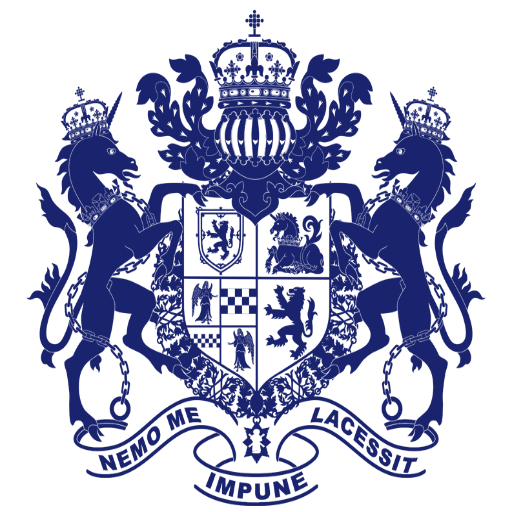
The Royal Arms and Cypher of HM Queen Liudmyla serve as the official heraldic embodiment of the Queen Consort within the restored Kingdom of Scotland. Incorporating traditional Scottish heraldic elements alongside symbols reflecting her distinguished sovereign status and heritage, these emblems visually assert the grace, cultural continuity, and independent constitutional dignity of the Crown under public international law.